
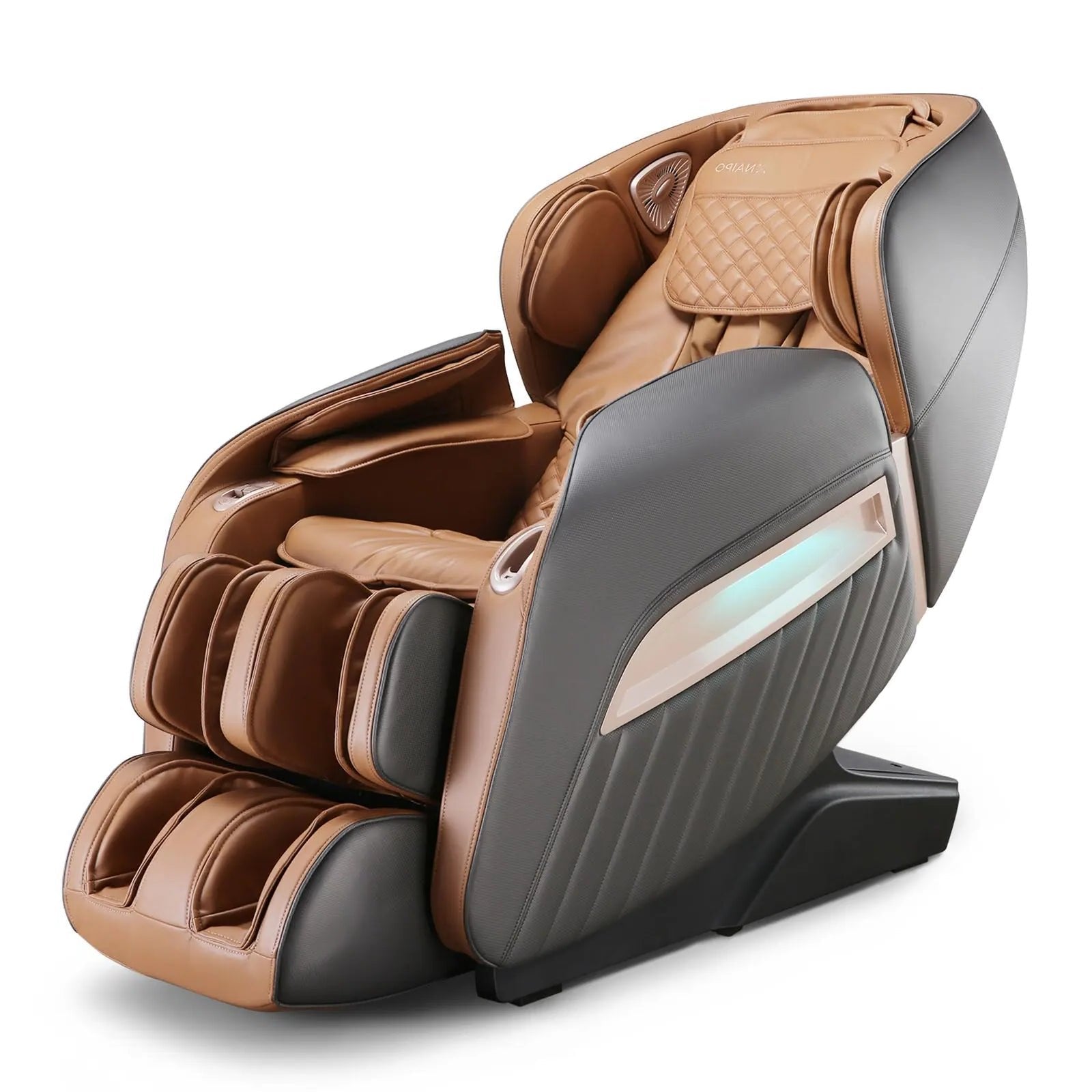





A massage chair costs between 1,500 and 10,000 euros. Given this price range, the question of how to pay is often just as important as the question of which model to choose — particularly for the self-employed, medical practices and businesses, where tax treatment and cash flow are key considerations. This article compares cash purchases, hire purchase and leasing, and explains what to look out for in the terms and conditions.
- Used Massage Chair: The Inspection Points
- How much does a massage chair cost? [Expert answers]
- Buying a massage chair with a prescription? What you should know
- Is a massage chair medically beneficial?
- Massage with a pacemaker: is a massage chair an option?
- Best massage chair for you: six NAIPO models compared
Show table of contents
Summary/TLDR
For private individuals, hire purchase is the usual option: the chair is yours straight away, and payment is spread over 6 to 48 months. Pay attention to the annual percentage rate (APR) — interest-free offers are genuine only if there is no hidden mark-up in the purchase price. Leasing is almost exclusively worthwhile for businesses: the instalments are immediately fully tax-deductible as business expenses, whilst a purchased chair is depreciated over its useful life. For businesses, it’s also worth noting that a massage chair can count as a workplace health promotion measure. When considering any offer, work out the total cost, not just the monthly instalment — this is where your perception is most likely to be skewed.
A comparison of the three options
| Cash purchase | Hire purchase | Leasing | |
|---|---|---|---|
| Ownership | Immediate | immediately | with the lessor |
| Liquidity | full amount immediately | saved | saved |
| Total costs | lowest | depending on the interest rate | usually the highest |
| For tax purposes (commercial) | Depreciation over useful life | Depreciation, interest treated as an expense | Instalments are fully deductible immediately |
| For private individuals | ideal, if possible | the standard case | rarely advisable |
| End of term | — | The armchair has been paid for | Return or purchase at residual value |
| Room for negotiation | at its greatest | medium | low |
Cash purchase: almost always the cheapest option
The unspectacular but mathematically best option — provided the money is available and isn’t needed more urgently elsewhere. Two points that are often overlooked:
- cash discounts and rebates. When paying immediately, there’s the greatest scope for negotiation. Ask specifically — for four-figure sums, a discount is often possible.
- Display models. Armchairs from the showroom are often in perfect condition, lacking nothing but the original packaging, yet the discount is often substantial. You can find out what to look out for in ‘Buying second-hand massage chairs ’.
Hire purchase: the norm for private buyers
With hire purchase, the sales contract takes effect immediately, and payments are handled by a finance partner. The chair is yours from day one — unlike with leasing.
What you need to bear in mind:
- Annual percentage rate ( APR ), not the nominal interest rate. Only the APR includes all additional costs and allows for a fair comparison.
- Total amount rather than monthly instalments. A small instalment may sound harmless, but over a long term it still adds up. Always calculate instalment × term and compare with the cash price.
- Check interest-free offers. They’re genuine if the cash price is the same. Ask explicitly: “How much does the armchair cost if paid for in full?” If the cash price is lower, you’re effectively paying the interest as part of the purchase price.
- Residual debt insurance is optional and rarely cost-effective. It is often pre-ticked.
- Extra repayments. With consumer loans, early repayment is permitted by law; for terms exceeding twelve months, a limited early repayment charge may apply.
- Cancellation. A 14-day cancellation period applies to consumer loan agreements.
Typical terms range from 6 to 48 months. As a rule of thumb: the term should be significantly shorter than the expected lifespan of the appliance — see ‘How long does a massage chair last?’.
Leasing: a commercial arrangement
With leasing, you hire the chair for a fixed term, usually 24 to 60 months. The lessor remains the owner. At the end of the term, you can return it, extend the lease or buy it at its residual value.
For private individuals, this is rarely worthwhile. Without the tax benefits, it is simply a rental arrangement which, over the term, is usually more expensive than hire purchase — and in the end, you own nothing.
The situation is different for businesses:
- Instalments are treated as business expenses and are fully deductible from profits in the year of payment. An armchair purchased outright, on the other hand, is depreciated over its normal useful life — the cost is spread over several years.
- Balance sheet neutral. With a standard operating lease, the asset does not appear on your balance sheet, which helps to preserve key financial ratios and credit lines.
- Predictability. Fixed instalments, often including maintenance.
- No residual value risk with the return model.
What to look out for in the contract: Is it a full amortisation lease or a residual value lease? Who is responsible for maintenance and repairs? What is the calculated residual value, and do you have to guarantee it? What return criteria apply to the condition of the asset? A residual value set too low will ultimately make the offer expensive.
Purchasing massage chairs for commercial use
Additional considerations apply for practices, studios, hotels, fitness centres and businesses with relaxation rooms.
Depreciation on purchase
A purchased massage chair is a depreciable movable fixed asset and is depreciated on a straight-line basis over its normal useful life. The exact classification — useful life, possible special depreciation allowances for small businesses, investment allowance — depends on the individual case and should be handled by your tax adviser. The rules also change regularly.
Input VAT deduction
Businesses eligible for input VAT deduction may claim back the VAT, provided the purchase is for business purposes. This significantly reduces the effective cost — a point that is often overlooked when comparing prices with those for private use.
Workplace health promotion
Measures to promote staff health may be eligible for tax relief. Whether a massage chair falls under this category in a specific case depends on its design and use and cannot be answered in general terms — this, too, is a matter for your tax adviser. For information on offering massage chairs as an employee benefit, see Massage chairs as an employee benefit and Suitable massage chairs for offices and businesses.
Coin-operated chairs
Anyone making the chair available to guests or customers for a fee will need a payment system. See Massage chairs with coin slots for more on this.
All tax information in this section is for general guidance only and is no substitute for tax advice. Useful lives, depreciation rules and allowances are subject to change; the information provided by your tax adviser is binding.
The fourth option: hire
For short-term needs — an event, a trade fair, a trial period, a staff outing — renting is the simplest solution. No long-term commitment, no concerns about residual value, and set-up and dismantling are usually included. As a long-term solution, it is the most expensive option. Terms and conditions can be found on the Rent a massage chair page.
Renting is also a useful way to help you decide: spending two weeks using the chair in your everyday life will give you a better idea of whether to buy it than any trial session. See also Trying out massage chairs.
How to work out the costs
Take the cash price of the chair as your benchmark and compare each offer against it:
- Cash purchase with a discount: You pay a one-off amount lower than the list price. This is the cheapest option.
- Interest-free hire purchase, cash price unchanged: The total of all instalments is exactly the purchase price. No additional costs — the financing is effectively free.
- Interest-bearing instalment plan: The total of all instalments exceeds the purchase price. The difference is the cost of the finance.
- Commercial leasing: Instalments depend on the residual value; the total amount is usually higher than the purchase price, though the tax implications may offset this depending on your situation.
The calculation highlights the key point: a genuinely interest-free offer is, mathematically speaking, just as good as a cash payment without a discount. Interest-bearing finance is always more expensive — the only question is whether the liquidity you save is worth the extra cost.
Conclusion
Private: Cash purchase with a discount, if possible; otherwise, hire purchase, and then preferably a genuinely interest-free offer with the cash price remaining unchanged. Leasing is practically never worthwhile for private individuals.
Business: Compare the costs of leasing and buying. The immediate full deduction as a business expense when leasing is offset against depreciation and ownership when buying — which option is better depends on your specific tax situation, not on a rule of thumb.
In any case, the rule is: work out the instalment × term and compare it with the cash price. This single calculation exposes any poor offer in thirty seconds.
Frequently Asked Questions (FAQs)
Can you buy a massage chair on instalments?
Yes, most retailers offer instalment plans ranging from 6 to 48 months. The chair is yours from day one. Pay attention to the annual percentage rate (APR) and compare the instalment multiplied by the term with the cash price — this is the only way to tell whether an ‘interest-free’ offer is genuinely interest-free.
Is leasing a massage chair worth it?
Rarely for private individuals: over the term, you’ll usually pay more than with an instalment plan, and you won’t own anything at the end. For business purposes, it can be worthwhile because the instalments are immediately fully deductible as business expenses, whereas a purchased chair is depreciated over its useful life.
Can you claim a massage chair as a tax deduction?
If it’s for business purposes — such as a practice, studio, hotel or relaxation room within a company — then in principle yes, either through depreciation if purchased or as a business expense if leased, with input VAT deduction where applicable. The specific useful life, any special depreciation allowances and classification as a health promotion measure should be left to your tax adviser. Purely private purchases are not tax-deductible; for special medical circumstances, see massage chairs on prescription.
Which is cheaper: leasing or hire purchase?
In terms of the total amount paid, hire purchase is almost always cheaper, because with leasing, the calculated residual value and the lessor’s margin are factored into the price. For business purposes, however, leasing may still be more advantageous due to its immediate tax benefits — this can only be determined by looking at the specific figures.
Is it possible to finance a massage chair without a Schufa credit check?
Reputable providers carry out a credit check for hire purchase — this is a form of consumer protection required by law. Offers that explicitly advertise that they do not carry out a credit check usually come with significantly higher costs. If financing isn’t possible, a cheaper model, a display model or, initially, a massage pad are the more sensible options.
Can you rent a massage chair first and then buy it?
Yes, this is common practice, and some suppliers will apply part of the hire payments towards the purchase price. Make sure you ask about this explicitly before the hire period begins and have it set out in writing — it rarely works out that way afterwards.
- Used Massage Chair: The Inspection Points
- How much does a massage chair cost? [Expert answers]
- Buying a massage chair with a prescription? What you should know
- Is a massage chair medically beneficial?
- Massage with a pacemaker: is a massage chair an option?
- Best massage chair for you: six NAIPO models compared

Written by NAIPO Editorial Team · Massage & Product Experts from Hamburg
Product experts, service technicians, and massage enthusiasts at Alsterwell GmbH — specializing in massage technology for over a decade, with our own workshop and showrooms for test sitting.
Fact-checked by David Eberst · Co-founder of NAIPO



Leave a comment
This site is protected by hCaptcha and the hCaptcha Privacy Policy and Terms of Service apply.