
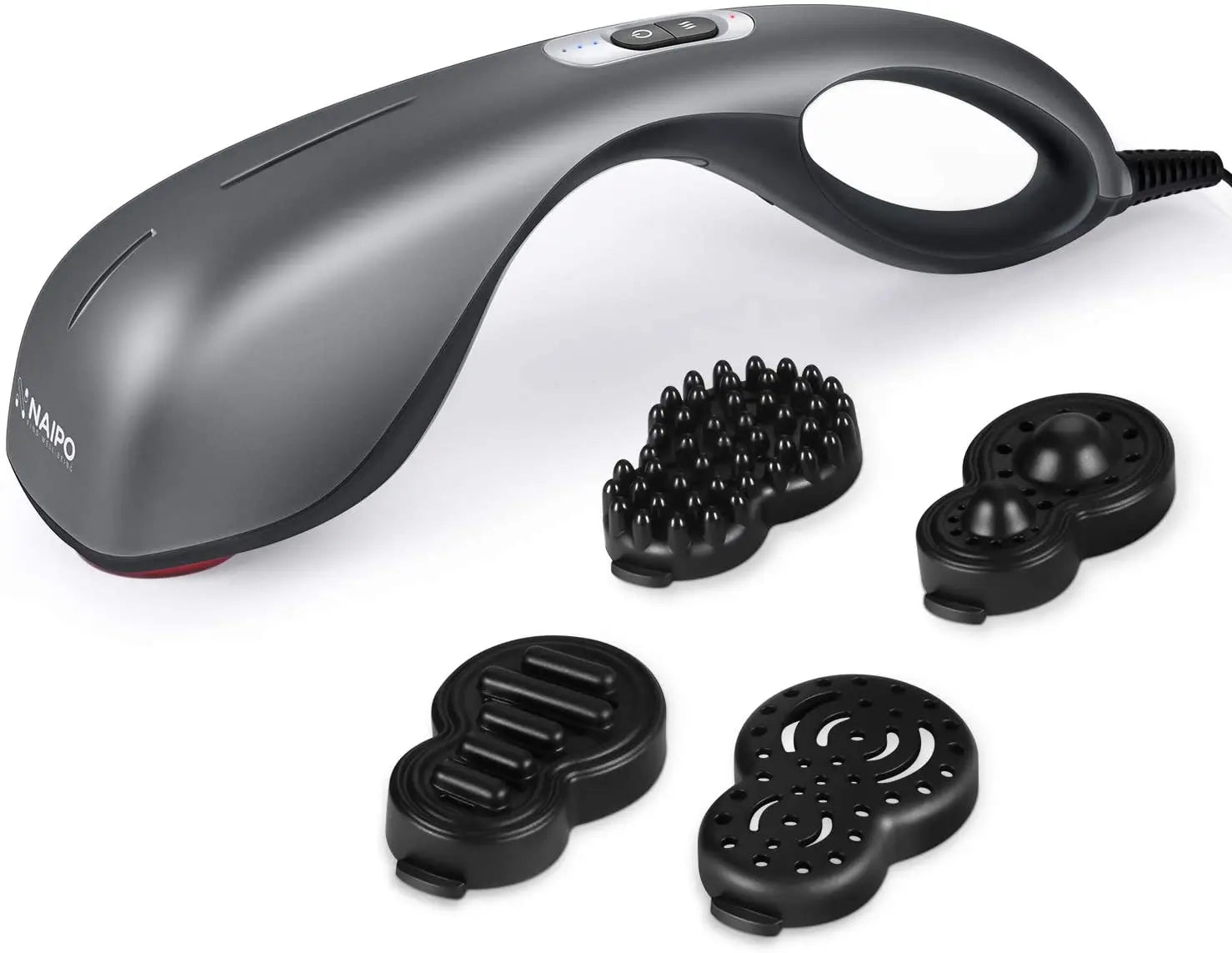





A back massager works alongside the spine, not on it. The row of bones in the centre of the back has no layer of muscle to cushion the pressure. The massage is applied to the two muscle groups to the left and right of this, about two to three fingers’ width from the centre.
Show table of contents
What lies in the centre
The lumps that can be felt along the centre of the back are the spinous processes of the vertebrae. They protrude backwards and, in most people, lie just beneath the skin and a thin layer of connective tissue. Beneath them runs the spinal canal containing the spinal cord.
Direct, repeated pressure on this row is undesirable for two reasons. It hurts because there is nothing there to cushion it. And it is ineffective because the tension is not in the bone, but in the surrounding muscles.
Where the work actually takes place
To the left and right of the spinous processes runs the erector spinae, a long muscle running from the pelvis to the neck. It keeps the upper body upright and is constantly under slight tension during office work. This is exactly where the massage heads are positioned.
That is why good devices have an adjustable distance between the massage heads. A narrow back requires a closer spacing than a broad one. If the distance is fixed and does not fit, the heads will run over the spinous processes instead of alongside them.
How to tell if the setting is incorrect
- Localised, stabbing pain in the centre rather than a dull pressure to the side of it.
- A clicking or rattling sound as the massage heads skip over the row of bones.
- Pressure marks the next day that lie exactly in a line.
If any of these occur, adjust the distance or change your sitting position. A rolled-up towel under your lower back often shifts the path just enough.
The lower back needs more attention
In the lumbar region, the spine curves forwards. A straight massage path hits the highest points of the curve particularly hard there, whilst the muscles in the hollow remain untouched. If you’re targeting the lower back, you’re better off with a contoured design.
You can find out which devices are suitable there in the article Massage devices for the lower back. Adjustable models for the entire back are listed under Back massage devices.
When not to use the device
Where there are known abnormalities of the spine, different guidelines apply compared to simple muscle tension. Osteoporosis, severe scoliosis, spondylolisthesis or conditions following spinal surgery must be assessed by a doctor before a device is used.
The same applies to pain that radiates into the arms or legs, numbness and loss of strength. These are signs of nerve involvement, and these should be investigated rather than massaged away. A device relieves muscle tension; it is no substitute for a diagnosis.
What a towel can do
The simplest way to correct the alignment is to use a rolled-up towel. Placed between the device and the back, it raises the contact surface and relieves pressure on the spinous processes. For narrow backs, this is often the most effective measure of all.
Two towels, placed lengthways to the left and right of the spine, have an even more targeted effect: they leave the centre free and direct the pressure onto the muscle groups. This costs nothing and, for many simple devices, compensates for the lack of adjustment to the width of the pads.
In the case of a slipped disc
If you have a disc problem, specific guidelines apply, starting with a medical assessment. What is possible afterwards and how to recognise when to stop is explained in the article Back massager for a herniated disc.
Frequently asked questions
Can a back massager be used directly on the spine?
No. The massage heads should be placed on the muscle groups to the left and right, about two to three fingers’ width away from the centre. Direct pressure on the spinous processes is painful and serves no purpose, as the tension in the muscles lies elsewhere.
What can be done if the device is too wide for a narrow back?
If the spacing between the massage nodes cannot be adjusted, two towels placed lengthways to the left and right of the spine will help. They leave the centre free and direct the pressure onto the muscles. You can find out what else to look for when buying one in the back massager test.
When should you consult a doctor first?
In cases of known conditions such as osteoporosis, severe scoliosis or spondylolisthesis, and following spinal surgery. The same applies to pain that radiates into the arms or legs, numbness and loss of strength.

Written by NAIPO Editorial Team · Massage & Product Experts from Hamburg
Product experts, service technicians, and massage enthusiasts at Alsterwell GmbH — specializing in massage technology for over a decade, with our own workshop and showrooms for test sitting.
Fact-checked by David Eberst · Co-founder of NAIPO



Leave a comment
This site is protected by hCaptcha and the hCaptcha Privacy Policy and Terms of Service apply.