


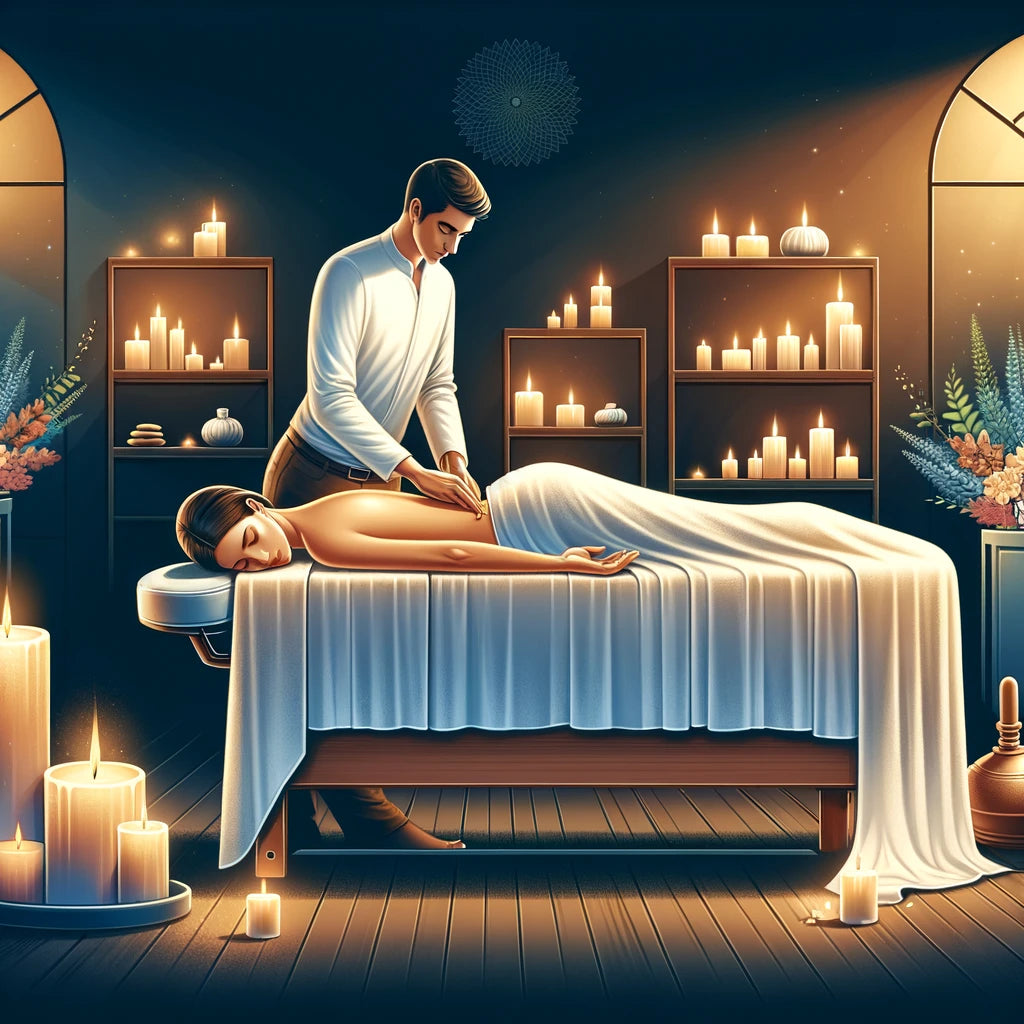



During a full-body massage, the therapist uses five basic techniques: stroking, kneading, rubbing, tapping and vibration. Each area of the body receives its own combination of these techniques, and the order is almost always the same. Here’s what each technique achieves, what actually happens to your back, legs, arms and neck, and how you can tell that the massage is being performed properly.
Show table of contents
The five basic techniques
- Stroking. Broad, gliding strokes using the whole hand, usually towards the heart. This is how almost every area begins and ends. It distributes the oil, warms the tissue and gives the body time to adjust to the touch.
- Kneading. The muscles are lifted between the thumb and fingers and worked through, much like dough. This is the very essence of the massage and the technique most people think of when they think of massage.
- Rubbing. Small, circular movements with the thumb or fingertips, applied precisely to a specific, tense area. The most intense of the five techniques and the one most likely to make you flinch.
- Tapping. Short, light taps with the edge of the hand or the palm. This has a stimulating rather than a calming effect, so it is more commonly used towards the end of a session or in a sports massage.
- Vibration. A gentle shaking motion with the hand resting on the skin. Often used to finish off a specific area.
No massage studio rigidly sticks to all five techniques. Good therapists vary their approach depending on what they feel beneath their hands. Anyone wishing to try a full-body massage at a studio can find regional massage offers on Groupon (advertisement).
What each area receives
Back. The longest section, usually taking up a third of the time. First, broad strokes along the entire length, then kneading the muscle strands to the left and right of the spine, followed by targeted rubbing of the tight areas. The spine itself is not worked on, only the areas alongside it.
Neck and shoulders. The area that is most commonly tense. Here, the work is more detailed, often whilst sitting or with the head turned to one side. The trapezius muscle between the neck and shoulder receives the most attention.
Legs. First the back – calves and the back of the thighs – then the front whilst lying on your back. Strokes are applied from the bottom upwards, i.e. towards the heart. The back of the knee is avoided, as blood vessels run close to the surface of the skin there.
Feet. Firm thumb pressure on the sole, moving the toes through their range of motion. For many, this is either the most pleasant or the most ticklish part; there is little in between.
Arms and hands. Kept brief, usually two to three minutes per side. Stroke from the wrist to the shoulder, knead the upper arm, apply thumb pressure to the palm.
Abdomen. Only with express consent and always very gently, using clockwise circular movements.
The sequence
Almost all studios work their way up from the legs and start with the client lying on their front: the backs of the legs, the back, the neck and the shoulders. Then you turn over, and the session continues with the fronts of the legs, the arms, the abdomen if required, and often finishes with the neck and head once more.
The reason for this order is practical: the back takes the longest to treat and is therefore addressed early on, whilst there is still plenty of time left in the session. As for the rest of the process, from reception to the post-massage rest period, you can read about it here: how a full-body massage is carried out.
What the individual techniques are intended to achieve
Each technique has its own specific aim. I say this cautiously, as the body of research on massage as a whole is less extensive than advertising would have us believe:
- Stroking prepares the body. It warms up the tissue and reduces the defensive tension with which every body reacts to a stranger’s touch. Without this initial stage, everything that follows feels harsher.
- Kneading targets the muscles themselves. Many people describe a feeling of relaxation in the treated area afterwards.
- Rubbing works on individual tight spots. This is the technique where a spot initially feels uncomfortable but often becomes noticeably softer afterwards.
- Tapping has a stimulating rather than a calming effect. That is why it is used before a competition and not at the end of a wellness treatment.
- Vibration concludes one area and transitions to the next.
How long the effects last varies from person to person. How often a treatment is advisable is covered in a separate article: how often you should go for a massage.
How to prepare
Not much, but it helps. Don’t eat immediately beforehand, especially nothing heavy, as lying on your stomach can make the pressure on your abdomen uncomfortable. Have a shower beforehand; this isn’t just a matter of courtesy, but is more pleasant for both of you. Remove any jewellery and your watch, and tie long hair back.
At the start, mention two things: where you’re experiencing discomfort and which areas you’d prefer to be left out. Both are standard practice and nobody will ask about them. What to wear and what to take off: what to take off for a massage.
How to recognise a good massage
- The therapist will ask before moving on to a new area, particularly around the buttocks and abdomen.
- Pressure is built up gradually rather than applied at full strength straight away.
- The hands barely lose contact with your body, which keeps the session flowing smoothly.
- You can continue to breathe calmly throughout. If you have to hold your breath or tense up, it means the pressure is too much.
- You’ll be asked if the pressure feels right, not just at the start.
What is excluded
The genital area and breasts are not treated; the spine itself is not worked on, nor are the backs of the knees, the front of the neck or fresh injuries. What exactly is included and what isn’t is explained in detail in a separate article: which massage really does cover everything. The article on full-body massage provides an overview of duration, costs and types.
What a machine can do
A massage chair masters three of the five techniques: kneading via rotating rollers, tapping via rapid strokes and vibration. It can only perform stroking to a limited extent, and cannot perform precise rubbing on a single fixed point at all. However, it can cover the entire length of the back in ten minutes, every evening, without the need for an appointment. You’ll find an overview of the models here; smaller devices for specific areas are listed under massage devices. In Hamburg, you can also try out a massage chair by booking an appointment at the NAIPO Relax Lounge.
In a nutshell
- Five basic techniques: stroking, kneading, rubbing, tapping and vibration.
- The back receives about a third of the time, whilst the arms receive the least.
- The massage is performed from bottom to top and from the prone to the supine position.
- The spine, the backs of the knees, the front of the neck, the genital area and the chest are excluded.
- One device can perform kneading, tapping and vibration, but not precise rubbing.
Frequently asked questions
How long does a full-body massage usually last?
Usually 60 to 90 minutes. Shorter sessions only cover the whole body superficially, whilst longer ones allow more time for each area.
Is a full-body massage painful?
Generally speaking, no. Significant pressure may be applied to deeper muscle groups. Just say if it’s too strong; this is common and won’t be commented on.
How often should you have a full-body massage?
That depends on the reason. For relaxation, once a month is enough for many people; for persistent tension, more frequent sessions are common.
Can anyone have a full-body massage?
Most people can. You should seek medical advice beforehand if you have thrombosis, acute inflammation, a fever, recent injuries, osteoporosis or are taking blood-thinning medication.
What should you wear for a full-body massage?
The massage is performed directly on the skin; towels are used to cover the areas not being worked on at the time. You keep your underwear on. Please come in comfortable clothing that is easy to put on and take off.
Frequently asked questions

Written by NAIPO Editorial Team · Massage & Product Experts from Hamburg
Product experts, service technicians, and massage enthusiasts at Alsterwell GmbH — specializing in massage technology for over a decade, with our own workshop and showrooms for test sitting.
Fact-checked by David Eberst · Co-founder of NAIPO



Leave a comment
This site is protected by hCaptcha and the hCaptcha Privacy Policy and Terms of Service apply.