


A foot massager does not treat polyneuropathy and does not repair nerves. Even so, many people with the condition find a gentle massage pleasant. The research on this is thin: studies have mostly looked at massage by therapists, vibration platforms and electrical nerve stimulation, and hardly at devices for home use. If you want to try one, look for a genuinely gentle lowest setting and heat that can be switched off, and check your feet after every session. There is no “test winner” specifically for polyneuropathy. Talk to your GP before you start.
Show table of contents
- Next article: Who should not use a foot massager? Main contraindications
- Next article: Best foot massager for neuropathy: what to look for
- Next article: Reflexology for neuropathy: what it can and cannot do
- Next article: EMS foot massager instructions: how to use it correctly
- Next article: Foot massager benefits: do they work and who are they for?
- Next article: EMS foot massager: benefits, side effects and is it safe?
This guide works through the questions in order: what a device can do, what the research says, which type suits you, what lies behind “test winner” badges, where EMS fits in and when to leave the device alone. Related reading: when foot massagers should not be used and the criteria for choosing a foot massager with polyneuropathy.
Does a foot massager help with polyneuropathy?
Not against the condition itself. A device does not act on the damaged nerves and does nothing about the cause, whether that is diabetes, alcohol, a vitamin deficiency or a medication.
What remains is a massage: it loosens the foot muscles, warms the feet and many people experience it as soothing. For some, the tingling or burning fades into the background for a while; for others, any touch is unpleasant. Both are normal with polyneuropathy, because the nerves report sensations unreliably. If you buy one expecting your symptoms to go away, you will be disappointed. If you are looking for a pleasant routine and know the limits, you often will not be.
What do studies say about massage for polyneuropathy?
There are a few small studies, but none that has tested an ordinary home foot massager in people with polyneuropathy. We did not find one when we searched PubMed (as of November 2026). This is what has been studied:
- Thai foot massage by therapists (Chatchawan 2015): 60 people with type 2 diabetes and neuropathy, 30 minutes three times a week for two weeks. The massage group did better than the control group in a walking and balance test, and range of motion and foot sensation improved. This was massage by hand, not a device.
- Vibration platform (Kessler and Hong 2013): Eight participants with painful diabetic neuropathy stood on a whole-body vibration platform three times a week for four weeks. Their pain scores fell. With no comparison group and only eight people, that is an early hint, not proof.
- Electrical nerve stimulation (TENS): One systematic review found a small advantage of TENS over sham treatment in painful diabetic neuropathy (Stein 2013). A Cochrane review of 15 studies, on the other hand, rates the quality of evidence for TENS in nerve pain as very low and reaches no firm conclusion (Gibson 2017).
An honest summary: massage and vibration were well tolerated in these studies. It does not follow that a foot massager influences the condition. The hands-on approach is covered in foot reflexology for polyneuropathy.
Neuropathy or polyneuropathy: what is the difference?
The two terms are often used interchangeably, but they do not mean the same thing. Neuropathy means a nerve is damaged. Polyneuropathy means many nerves are affected at once, usually symmetrically and usually starting in the feet and hands. Common causes are diabetes, alcohol, vitamin deficiency and infections.
For using a foot massager, the difference matters little: numbness, tingling and burning feel similar. Everything here applies to both.
Which foot massager for polyneuropathy?
The gentlest one that can be finely adjusted. When sensation is impaired, too much pressure or heat is the main risk, not too little power.
| Type | What it feels like | With polyneuropathy |
|---|---|---|
| Shiatsu and kneading | rotating nodes, deep into the tissue | the strongest type, only with a very gentle lowest setting |
| Vibration | broad, light tingling | usually the best tolerated on sensitive skin |
| Air compression | air cushions wrap the foot in waves | no pinpoint pressure, check the fit |
| EMS (electrical stimulation) | twitching and tingling, no kneading | a special case, only after medical advice |
Add four checks: Can the intensity be turned well down? Can the heat be switched off separately? Does the device switch itself off after a set time? Can you reach the controls while seated, without bending down? The full checklist is in the six criteria for polyneuropathy.
One example from our UK range: the Aspria 2-in-1 calf and foot massager works with air cushions rather than kneading nodes and has three pressure levels and two heat levels. Start on the lowest of each. All models are in the foot massagers overview. Which types of device beyond the foot are worth considering is compared in Which massager for polyneuropathy?.
Is there a “test winner” for polyneuropathy?
No. We are not aware of any independent test that compares foot massagers specifically for polyneuropathy. “Test winner” and “best buy” are not protected terms.
Most badges in this area come from comparison websites that evaluate spec sheets and customer reviews, often with affiliate links. That is not a laboratory test. For every badge, ask: who tested it, was the device actually used, and how old is the test?
EMS foot massager for neuropathy: worth it?
Only after medical advice. EMS mats work with electrical impulses and are often advertised for neuropathy, but a benefit of home devices has not been demonstrated.
If you feel less, you may only notice too high a setting late. Electrical stimulation is off limits with a pacemaker, defibrillator or other active implant, in pregnancy, with thrombosis and with open sores on the foot. Important safety note: not suitable for use by people with a pacemaker. What EMS does is explained in What does an EMS foot massager do?, and the risks in Is an EMS foot massager dangerous?. NAIPO itself does not sell EMS devices; our foot massagers work mechanically.
Diabetic polyneuropathy: what matters most
Diabetic polyneuropathy calls for more caution than any other form, for a simple reason: when the feeling in your feet fades, you notice too late that something is too firm or too hot. The international guideline on the diabetic foot focuses on foot care education for people at risk and on treating any early sign of a wound promptly (IWGDF 2023). In the UK, the NHS advises people with diabetes to have their feet checked at least once a year; your GP surgery or diabetes team can tell you more.
- Gentle, not strong. The skin is often more sensitive and injures more easily. Finely adjustable settings matter more than plenty of power.
- Heat only under control. Never test the temperature with your foot; use the back of your hand or your elbow.
- Look at your feet afterwards. After every session, check for redness, pressure marks or small injuries. What you cannot feel, you have to see.
- Get medical advice once. Before the first use, not after the first problem.
More on this in Are foot massagers suitable for people with diabetes?.
How do I use a foot massager correctly with neuropathy?
Short, gentle and regular. Start on the lowest setting for a few minutes; 10 to 15 minutes a day is usually enough.
- Start low: the gentlest setting first, without heat, and increase slowly.
- Often and short: ten minutes a day rather than half an hour once a week.
- Watch for signals: if tingling, burning or numbness increases, stop and ask your GP.
How long a session should last in general is covered in How long can you use a foot massager?.
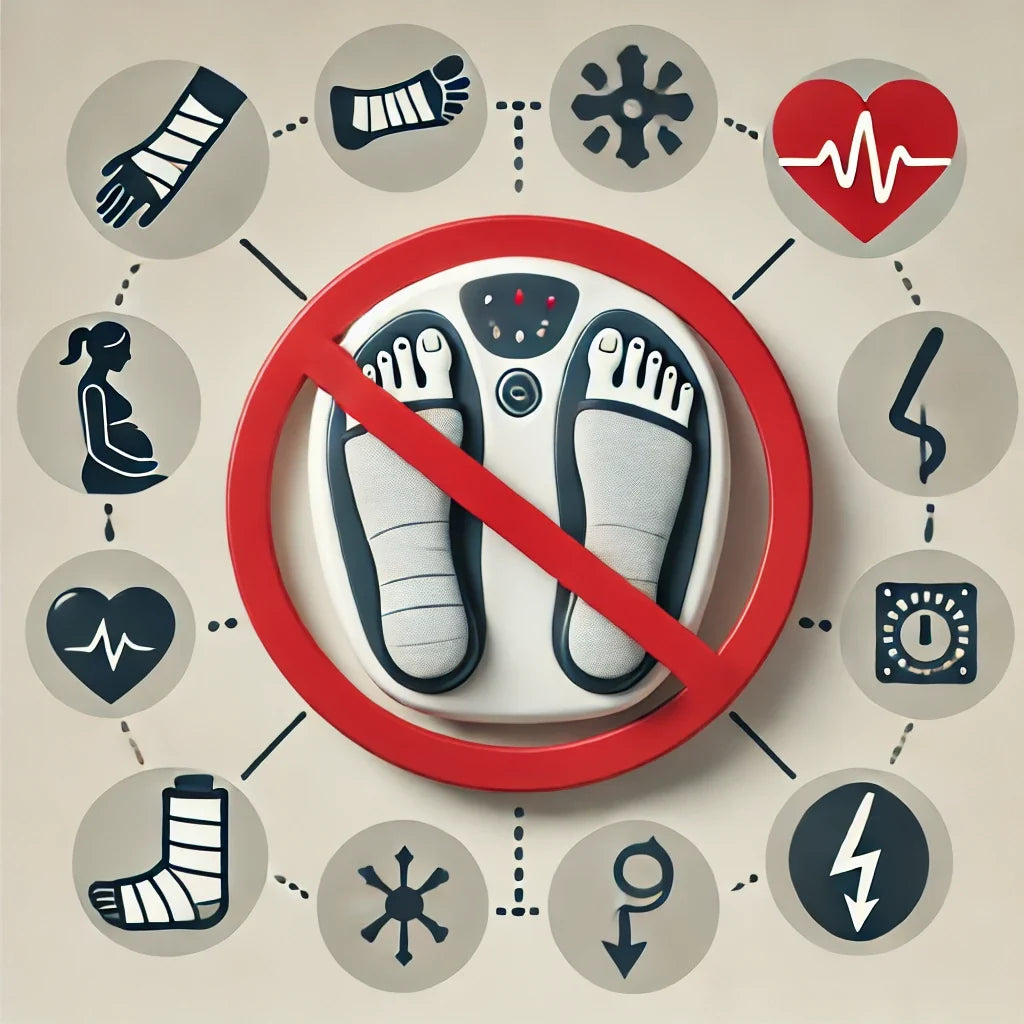
When not to use a foot massager
- Open wounds, ulcers or inflammation on the foot.
- Recent injuries or recent surgery on the feet or legs.
- Thrombosis or suspected thrombosis. If a calf is swollen, warm or painful, seek medical advice straight away.
- Severe circulation problems in the legs, unless your doctor has explicitly cleared the device.
Frequently asked questions
Does foot massage help with neuropathy?
A foot massage can feel pleasant and loosen the muscles. In one small study, Thai foot massage by therapists improved balance and foot sensation (Chatchawan 2015). It is not a treatment for neuropathy.
How often should I use a foot massager with polyneuropathy?
10 to 15 minutes a day is usually enough. Start with shorter sessions on the lowest setting.
Are there side effects?
Possible effects are skin irritation, pressure marks, bruising or stronger tingling, especially with too high a setting or too much heat. If that happens, stop and ask your GP.
Which foot massager is best for polyneuropathy?
The one whose lowest setting is genuinely gentle, whose heat can be switched off and which fits well. There is no overall winner, because symptoms vary too much from person to person.
Sources
- Chatchawan U et al. (2015): Effects of Thai foot massage on balance performance in diabetic patients with peripheral neuropathy: a randomized parallel-controlled trial. Medical Science Monitor Basic Research 21. doi.org/10.12659/MSMBR.894163
- Kessler NJ, Hong J (2013): Whole body vibration therapy for painful diabetic peripheral neuropathy: a pilot study. Journal of Bodywork and Movement Therapies 17(4). doi.org/10.1016/j.jbmt.2013.03.001
- Stein C et al. (2013): Electrical stimulation and electromagnetic field use in patients with diabetic neuropathy: systematic review and meta-analysis. Brazilian Journal of Physical Therapy 17(2). doi.org/10.1590/S1413-35552012005000083
- Gibson W, Wand BM, O'Connell NE (2017): Transcutaneous electrical nerve stimulation (TENS) for neuropathic pain in adults. Cochrane Database of Systematic Reviews. doi.org/10.1002/14651858.CD011976.pub2
- Bus SA et al. (2023): Guidelines on the prevention of foot ulcers in persons with diabetes (IWGDF 2023 update). Diabetes/Metabolism Research and Reviews 40(3). doi.org/10.1002/dmrr.3651
This guide does not replace medical advice. If you have symptoms, existing conditions or any uncertainty, ask your GP before the first use.
If you enjoy foot massage: the massage chairs overview has models that massage feet, legs and back in one session. How the devices work in principle is explained in How does a foot massager work? and What are foot massagers good for?.
Frequently asked questions
- Who should not use a foot massager? Main contraindications
- Best foot massager for neuropathy: what to look for
- Reflexology for neuropathy: what it can and cannot do
- EMS foot massager instructions: how to use it correctly
- Foot massager benefits: do they work and who are they for?
- EMS foot massager: benefits, side effects and is it safe?

Written by NAIPO Editorial Team · Massage & Product Experts from Hamburg
Product experts, service technicians, and massage enthusiasts at Alsterwell GmbH — specializing in massage technology for over a decade, with our own workshop and showrooms for test sitting.
Fact-checked by David Eberst · Co-founder of NAIPO


Leave a comment
This site is protected by hCaptcha and the hCaptcha Privacy Policy and Terms of Service apply.